
Busy professionals don’t usually fail because they “lack motivation.” They fail because life is noisy: meetings run long, energy dips, Slack pings, kids need something, and your best intentions get pushed to “tomorrow.”
That’s exactly why implementation intention (also called If–Then planning) is so effective: it turns a vague goal (“I’ll work out more”) into a pre-decided response to a real-life trigger (“If it’s 6:30pm and I close my laptop, then I put on my shoes and walk for 10 minutes”). This strategy was developed and researched extensively by psychologist Peter Gollwitzer, and evidence suggests If–Then plans can meaningfully improve follow-through and goal attainment.
Below you’ll get a clear structure, practical examples for modern workdays, common pitfalls, and a simple worksheet you can copy into Notion or print.
What is an implementation intention?
An implementation intention is a simple planning format:
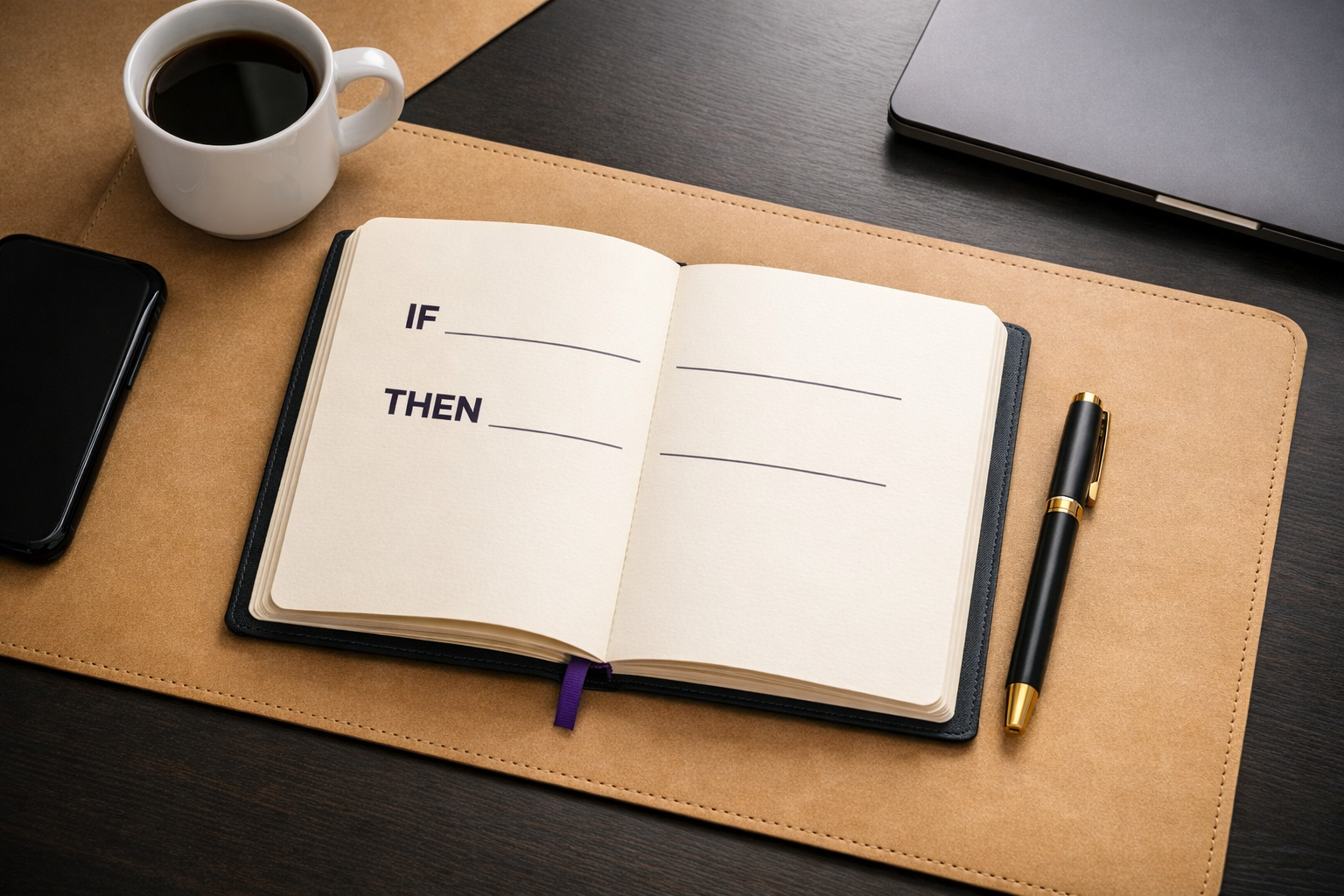
If (a specific situation happens), then (I will do a specific action).
The power is not in positive thinking—it’s in automation. You decide the action before the moment arrives, so you don’t rely on willpower when you’re stressed, tired, or distracted. Research and meta-analytic evidence supports that this type of planning can improve goal achievement, often with medium-to-large effects depending on context and design.
The 5-step structure that works for busy professionals
1) Pick one priority behavior (keep it small)
Choose the one habit with the highest return right now. Think “minimum effective dose,” not life overhaul.
Examples:
-
10-minute walk after work
-
2-minute breathing reset before tough calls
-
Protein-forward breakfast 4 days/week
2) Choose a trigger that already happens (reliable cue)
The trigger must be concrete and predictable:
-
Time-based: “At 7:30am…”
-
Event-based: “After I start my coffee machine…”
-
Location-based: “When I enter the office…”
3) Define a specific action (clear, doable, measurable)
Avoid fuzzy verbs like “be healthier.” Use actions you can see.
4) Add friction removal (make the “Then” easier)
Pre-set your environment so the action is the default:
-
Shoes by the door
-
Water bottle on desk
-
Calendar block for deep work
5) Rehearse and review (30 seconds)
Read your If–Then plan out loud once daily for a week. Then review weekly and tighten what didn’t work.
Implementation intention examples for real workdays
Use these as templates (swap in your reality):
Energy, focus, and deep work
-
If it’s 9:00am and I open my laptop, then I start a 25-minute focus sprint on my #1 task (phone in another room).
-
If I feel the urge to check email during deep work, then I write it on a sticky note and return to the task.
Movement (without “finding time”)
-
If I finish a meeting, then I stand up and do 10 bodyweight squats or a 60-second walk.
-
If it’s 3:00pm, then I walk for 5 minutes before my next call.
(For more workplace-friendly habit ideas, see our internal guide on building a healthier work setup and routine: Healthier Workspace Habits.):
https://www.berracosfitness.com/healthier-workspace-habits-health/
Stress and emotional regulation
-
If I feel my chest tighten before a difficult conversation, then I do 6 slow breaths (in 4, out 6) before I speak.
-
If a meeting runs over, then I send a 2-line update to reset expectations instead of silently absorbing stress.
Nutrition for busy schedules
-
If I pour my first coffee, then I drink 300–500ml of water first.
-
If I order lunch, then I add a protein + a plant (lean protein + salad/veg) before any extras.
Common pitfalls
-
Triggers that aren’t real
-
“If I have time…” is not a trigger.
-
Fix: use a real event—“After I close Zoom,” “When I sit at my desk.”
-
Actions that are too big
-
“Then I do a full workout” collapses under pressure.
-
Fix: “Then I do 10 minutes.” Consistency first.
-
Too many If–Then plans at once
-
The brain treats it like clutter.
-
Fix: run one plan for 7–14 days, then add another.
-
No environment support
-
If your action depends on remembering, you’ll forget.
-
Fix: place cues in your path (bottle on desk, shoes by door).
-
No review loop
-
Plans degrade when schedules change.
-
Fix: a 5-minute weekly “If–Then audit.”
Simple Implementation Intention Worksheet (copy/paste)
Goal (1 sentence):
-
Example: “I want consistent energy and fewer afternoon crashes.”
Target behavior (small + specific):
-
I will: __________________________
IF (trigger: time/event/location):
-
If _____________________________ happens,
THEN (action: clear + doable):
-
then I will _______________________.
Make it easier (remove friction):
-
I will prep: ______________________
-
I will place: _____________________
-
I will block time: ________________
Plan B (when things go wrong):
-
If _____________________________ goes off track,
-
then I will _______________________ (minimum version).
Weekly review (2 minutes):
-
What worked? ____________________
-
What failed? _____________________
-
What will I tighten? ______________
Why this works
Implementation intention works because it links a specific cue to a specific response, increasing the chance you act automatically when the moment arrives—especially under stress and distraction. This is why it’s frequently used in behavior-change research and workplace habit design.
Related reading
If your goal includes body composition and you want to identify what’s quietly undermining progress, this article is a useful companion:
https://www.linkedin.com/pulse/fat-loss-busy-professionals-5-proven-habits-sabotage-results-hybgf/?trackingId=8gGv4POISBqtbqW8qp2mXw%3D%3D
Want a simple system to make these habits stick in real life? Download our free ebook at the end of this post—available right here on the page. Inside, you’ll also find an exclusive gift reserved for people who are genuinely ready to change their habits and improve their health. 1% better than yesterday.
